
Kava strainer bags: what to use and why
TLDR: The strainer bag is the difference between a smooth kava session and one that upsets your stomach. Use a 75 to 80 micron food-grade nylon bag, not cheesecloth or a t-shirt. Look after it by machine-washing with coloured clothes at 40 to 60 degrees Celsius, and give it the occasional boil or alcohol soak when residue starts to build up. Below: how strainer bags work, why the cheap alternatives fall short, and what we use ourselves.
Today we wanted to address one of the most common questions we get: why a strainer bag is essential when making kava from traditional powder, and why its quality matters.
Turning traditional grind kava into an effective, enjoyable drink is fairly simple, provided you have good kava and the right strainer bag. (If you are new to the process, our kava preparation guide walks through every step.) The kava itself is the more important factor, but the bag does make a noticeable difference to the result.

Making traditional kava: the basic principle
The active compounds in kava (kavalactones) are not particularly water-soluble. They do not simply dissolve when you pour water over the powder. Instead, you need to separate them from the root particles and get them suspended in the liquid. This is achieved by vigorously agitating the ground roots in water, either by hand or with a mixer. Think of the kavalactones as a thick, sticky resin that coats bits of wood. You want to consume the resin. You do not want to consume the wood, which can seriously upset your digestive system. That is where the strainer bag comes in.
The role of the strainer bag
If you prepare your kava the traditional way, the strainer bag lets you hydrate, squeeze, and agitate the root particles to release the kavalactones into the liquid, while keeping the indigestible woody fibres out of your shell. (As a side note, during this process some of the starches dissolve into the water, which makes kavalactone extraction a little easier.) High-speed blending also releases the resin into the water, but the mixture still needs to be strained afterwards, and our experiments suggest blending is not actually a better extraction method than a careful hand squeeze.
Many materials can be used to filter kava. A good kava strainer bag, however, can significantly improve both extraction and the quality of the resulting drink. Historically, kava was prepared from fresh green roots whose fairly large, soft particles (after mastication or grinding) were much easier to squeeze and filter using natural materials. These days most drinkers prepare their kava from dried, powdered roots, which contain much smaller particles (once dried, large particles are too hard for effective kneading).
By an appropriate strainer in the modern context we mean a bag fine enough to filter out the coarse fibres that can irritate the digestive system and dull the session, while still letting the kavalactone-rich resin through into the bowl. It also needs to be strong enough to withstand the pressure of kneading and sturdy enough to last many sessions without tearing or stretching out of shape.
Alternative strainers and why they fall short
Many new kava drinkers think they will be fine with cheesecloth, an old t-shirt, stockings, or even a metal mesh filter. These are certainly better than no filter at all, but they typically produce an inferior beverage: either full of irritating fibres, or weak because the cloth cannot withstand a proper squeeze.
What an optimal strainer bag looks like
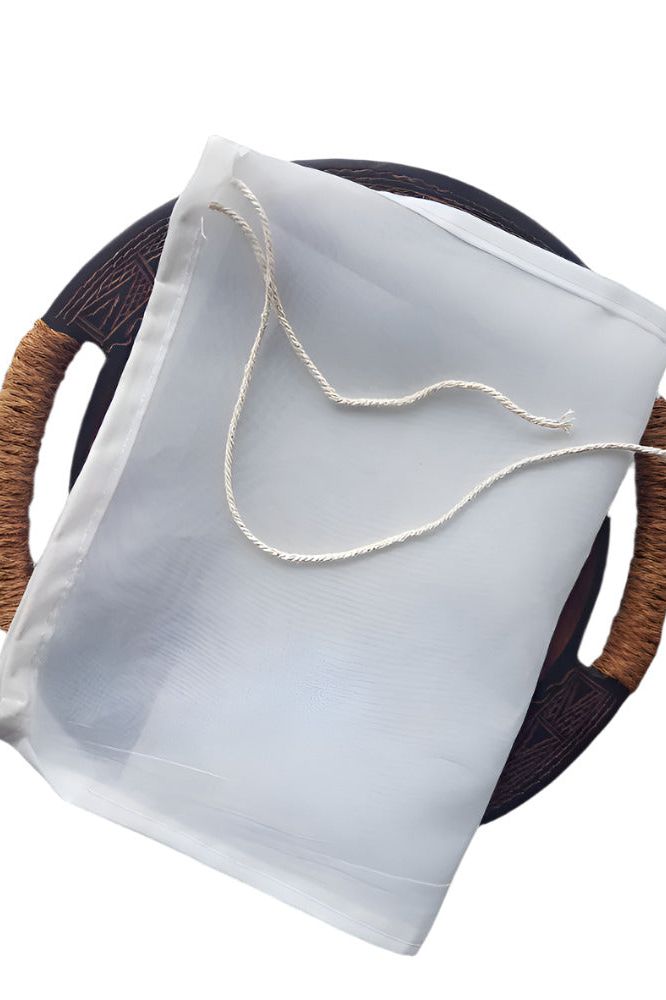
Over the years we have experimented with all sorts of filter cloths, sometimes intentionally and sometimes (especially early on) out of necessity. After a lot of trial and error we have settled on fine, food-grade nylon filter bags, similar to those used for almond milk. Bags like this can usually be found in health food shops, but they vary in size and pore size (the latter measured in microns). After trying many, we have decided that a 75 to 80 micron bag works best for most kava powders.
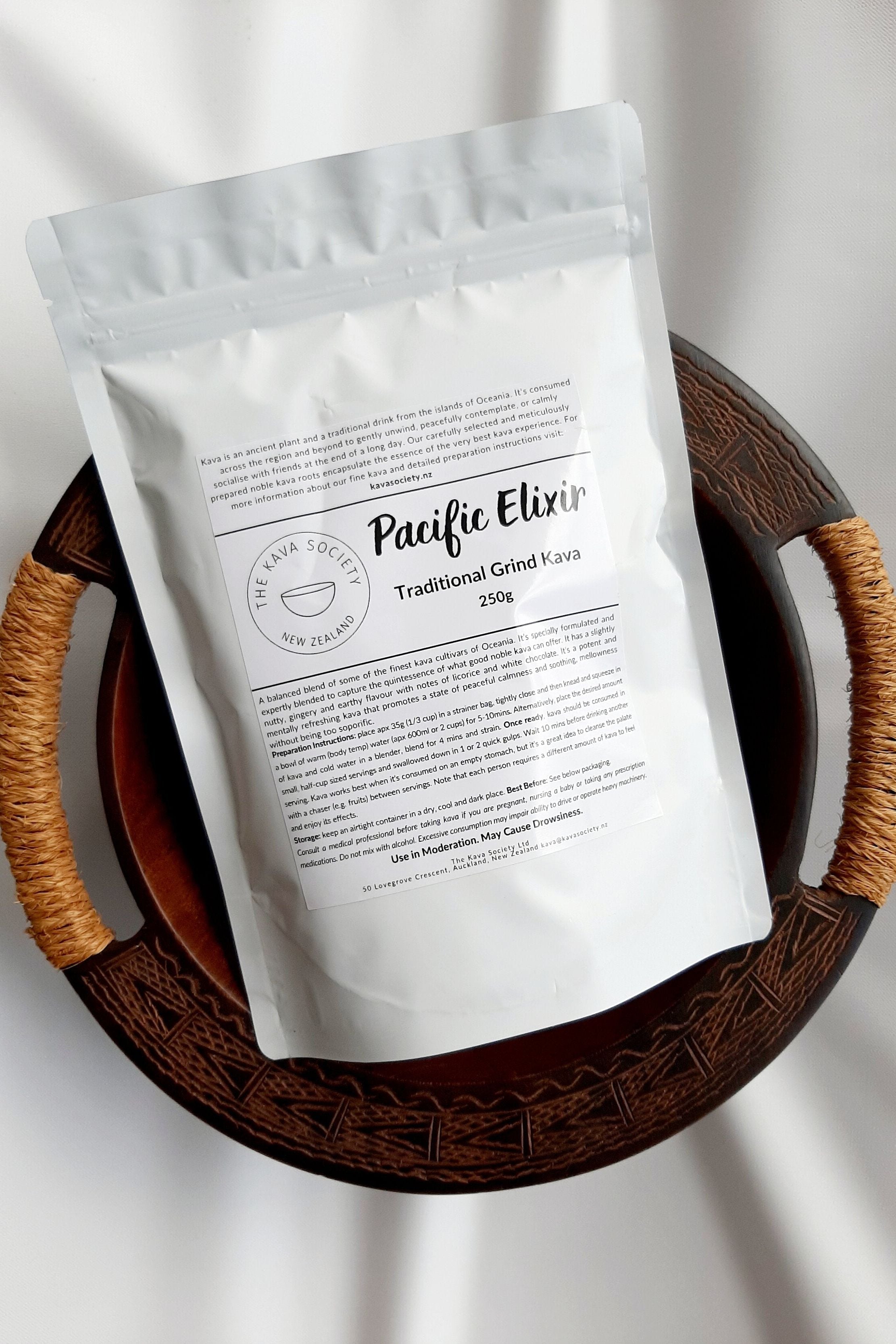
Different suppliers grind their kava to slightly different particle sizes. To some extent this is a matter of preference and equipment, but there is broad agreement on what counts as an optimal traditional grind: one that allows good extraction and good filtration. Too coarse and the resins do not release. Too fine and the woody bits cannot be filtered out (which is effectively what gets sold as micronised kava, and a reason we do not recommend it). We aim for our traditional powders to be ground to this optimal particle size, and it pairs well with the size of strainer bag we recommend.
To make sure all of our strainer bags are the right size and quality we custom-order them from a dedicated supplier and offer them through our online shop. You can find them here. We think they are possibly the best kava filter bag on the market. If you prefer a different supplier, look for a bag with a hole size no larger than 150 microns, ideally 100 microns or finer. Natural materials such as cotton or hemp can sound appealing, and bags made from them work, but they tend to wear out faster than nylon and it is harder to find one fine enough to give the same level of filtration.
Looking after your strainer bag
A strong nylon filter bag can last for months, but some basic care helps with both performance and hygiene. The easiest approach is to wash it in the machine with other coloured clothes (kava resin is yellowish and can stain whites) using a gentle natural detergent. A temperature of 40 to 60 degrees Celsius works best. Worth keeping a few bags on hand so you always have a clean one while the others go through the wash.
You can also wash by hand with warm water and soap, although this may not break down all of the sticky residue, and over time the bag can become clogged. If yours starts to feel sticky or congested and no amount of normal washing seems to fix it, try boiling it, or soaking it in high-percentage alcohol (rinse thoroughly afterwards). The alcohol soak dissolves the residual resin almost completely.
Get a proper bag
If you have been struggling with cheesecloth or a t-shirt, a proper bag will change your kava sessions. Our food-grade nylon kava strainer bag is the one we use ourselves at the Four Shells Kava Lounge, and the one we recommend to every customer who buys traditional grind kava from us.











Leave a comment
This site is protected by hCaptcha and the hCaptcha Privacy Policy and Terms of Service apply.