How Our Kava Is Made
If you've tried our kava, you know it's of insanely high quality. This is particularly obvious if you've ever tried any other kava, but even if you are completely new to kava, you have most likely noticed how clean, consistent, potent and aromatic our kava is.
That quality comes down to two things. Outstanding plant material, grown by skilled farmers on the islands best suited to each cultivar. And meticulous processing, which is the half almost everyone overlooks.
The processing happens in our Vanuatu partners' facility on Espiritu Santo, where these methods were developed and refined over many years. This page follows the path from a kava garden to the sealed bag at your door.
From Garden to Sealed Bag
Fifteen steps, in rough order. Some run in parallel, and instant kava takes one extra turn before drying.
-
Grown
It starts in customary gardens across Vanuatu, in a pristine environment of volcanic soil and clean water. More than a thousand growers supply the factory, concentrated on Santo, Epi, Pentecost and the Banks. Under the Vanuatu Kava Act, kava must be grown organically, and only noble cultivars may be exported. Everything we sell is both.
 Always noble, always organic
 -
Harvested
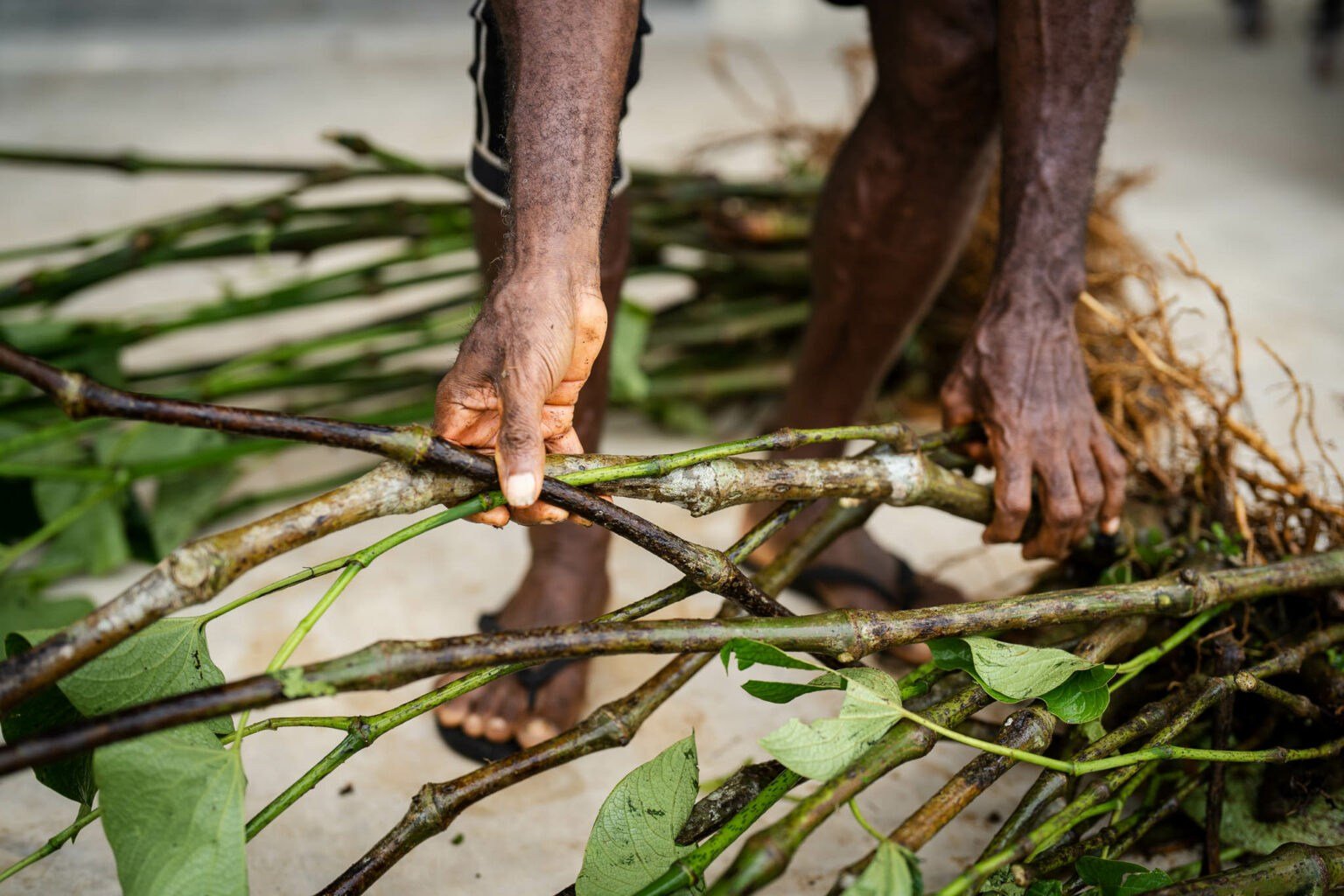
Only mature noble plants are lifted, four years and older. The cultivar is identified in the field before anything is cut, because one misidentified plant would carry through every step that follows.
 Only mature plants, four years and older
 -
Trimmed for the Trip
The root ball comes up and the tops are cut back for the trip out, but never cut flush. Two or three nodes stay attached to every root ball, and a couple of stalks keep their branches and leaves. Those leftovers are how the factory confirms the plant's identity when the load arrives.
-
Checked on Arrival
Several complete plants travel with every load, above-ground parts and all. Between those and the nodes left on each root ball, the field identification is confirmed a second time at the factory. Onsite analysts also assess the load independently for freshness and contamination, and their report has to match the harvest team's.
 Plants are often inspected prior to harvest to verify identity and quality.One cultivar per batch, checked twice
 -
Separated by Hand
Laterals and basal stump are parted by hand, one root ball at a time. The two behave differently in the cup, and the ratio between them is most of what gives a cultivar its character, so it is not a job to hand to a machine.
 Laterals and stump differ in the cup
 -
Sorted, Then Weighed Again
Roots arrive tangled and things get caught in them. A weed root, a stone, sometimes a fragment off a tool. The load is weighed once on arrival and again after all of that comes out, and it is the second number the grower is paid on. That gap tells the grower how clean their load was, which is why the washing floor is a lot less muddy than it used to be.
 Growers are paid on the clean weight
 -
Washed
Every speck of dirt is blasted off at high pressure. The water itself is purified on site and tested for sterility, pH and chlorine right before it touches a root. This is also where the decision is made on how much of the thin root bark to leave on.
 Washed in purified, tested water
 -
Chopped and Sliced
Kava root is brutal on machinery, and nobody builds machines for kava, so nearly every kind of chopping and slicing equipment ever made has been trialled in this factory. What survives the root is what we still use.

-
The Instant Step
This is where the instant range parts company with traditional grind. Freshly minced root is washed with cold water to separate the fine root material from the insoluble fibres you would otherwise strain out yourself. The fine material then goes through the same drying, testing and milling as everything else, only milled ultra-fine at the end. One ingredient: noble kava root. No straining, just mix with water.
One ingredient: kava root -
Evened Out, Then Dried
Tonnes of root arrive at different moisture levels, so the load is brought to an even moisture content before drying begins. Then the temperature has to sit inside a narrow window: high enough to meet strict microbiological limits, low enough that kavalactones do not start to degrade and take the flavour with them. The settings move as conditions move through the day, and nothing stays in the dryer a second longer than it has to. Drying is where good kava is most easily ruined, which is why the exact settings are the one part of the process not made public.
Dried in a narrow temperature window -
Screened for Microbes
Product and equipment are sampled at every stage, and again after production, and again before shipping. The protocols reliably detect trace amounts of over a hundred species. Nothing leaves that the people who made it would not happily drink themselves.
 Screening detects over 100 microbial species
 -
Milled
You will not get kavalactones out of a root by stirring it around in water. The surface area has to be enormous relative to the volume before extraction works at all, which is the entire reason kava is a powder. Every batch is milled to a consistent fine grind.
 Milled fine so kavalactones can extract
 -
Chemotype Measured
Every batch goes through UHPLC analysis, which produces the six-digit chemotype and tells us the balance of kavalactones in that particular harvest. The certificate is published, so anyone holding a bag can look up exactly what it was tested at.
Every batch tested, every certificate public -
Blended as It Grew
The powders from the different root types of one cultivar go back together in the ratio they actually grew in. Laterals are usually a little less abundant than basal roots, and that balance shifts from harvest to harvest, so a bag reflects what that batch really was.
 Harvests vary, like wine vintages
 -
Sealed and Shipped
Weighed on calibrated analytical balances, because nobody should buy a kilogram and get 950 grams. The oxygen is purged and replaced with nitrogen, each bag is vacuum sealed in low-permeability packaging, and the batch and production date go on the label. All of it before the kava leaves Vanuatu.
Nitrogen flushed, vacuum sealed


The Proof Is Public
Every batch has a certificate of analysis: the UHPLC chemotype and the microbiological screening, published for anyone to check.
Want the full detail? The complete seventeen-step guide covers everything above and more.

Organically Grown Noble Kava
100% pure noble kava from pristine volcanic soils. Our farmers cultivate specific single cultivars in regions best suited for each variety. Each plant matures for at least three years using traditional organic farming methods passed down through generations.
Always Processed from Fresh
Each batch is made from kava harvested to order, never from old village-dried stock. Plants are inspected on arrival for the right cultivar, for freshness, and for contamination. Anything that doesn’t pass is rejected.

Cleaned and Dried to Fresh Perfection
Freshly harvested roots are meticulously cleaned and dried using bespoke methods developed over years of research and refinement. The process preserves potency, fresh aroma, and active compounds. Each batch is then vacuum-sealed or nitrogen-flushed to lock in freshness.
Every Batch Tested
Our kava undergoes comprehensive testing using UHPLC analysis (superior to standard HPLC), full microbiological screening, and chemotype verification in an advanced in-house laboratory. Every batch comes with complete certificates of analysis and exceeds FSANZ Standard 2.6.3 requirements.
Check out our Certificates of Analysis