
Kneading kava: the science behind efficient traditional preparation
TLDR: Root & Pestle ran eight sequential 5-minute squeezes on the same bag of kava in fresh water each time. The first squeeze pulled 51.16% of the available kavalactones. The second added 14.17%. Subsequent washes diminished quickly. After eight washes total extraction reached 84.31%. The most useful takeaway: a single thorough squeeze gets you the bulk of the kavalactones. A second wash combined with the first can help stretch a batch, but anything beyond is more work than it is worth.
Traditional kava: why bother when there is instant kava?
Many people, especially those new to kava, value the convenience of instant kava. More experienced drinkers tend to gravitate towards the traditional grind form and patiently prepare it the old way. There is something inherently pleasant, relaxing, and grounding about traditional preparation. It takes a bit of extra time and some focused attention. Then there is the stronger, fresher aroma, the thicker creamier body, and the fuller, more complex taste of the resulting drink.
In many ways the difference between traditional grind and instant kava is like the difference between brewing coffee from whole beans and making instant coffee. Both forms deliver the active ingredients and the key taste characteristics, but preparing kava the traditional way produces a richer experience, particularly in a social context. As with instant coffee, the process of making instant kava inevitably involves some loss of fresh aroma, taste, and texture. Our goal has always been to offer dry kava that is as close to freshly harvested green plants as possible, and we keep inching closer to that ideal. This is how kava has been consumed for millennia, and drinking it in a form as close as possible to its authentic fresh state seems to produce the most wholesome and richest experience.
To be clear, the difference between our instants and our traditional kava is not enormous, and with further refinements to manufacturing and drying it may continue to shrink. Instant kava is a fantastic option in many contexts. We are very proud of the instant range we offer, particularly the single cultivar instant kavas. While not as aromatic and rich as our traditional grind, our instants are just as effective and they capture the character of each respective cultivar. We are also confident that our instant kava is far closer to fresh kava than virtually any other dry kava on the market.
Instant kava is a great way to start drinking kava, to try different cultivars, to experiment with dosage and style, even to combine kava with other flavours like coconut water or fresh juice. Not everyone has the time or ability to knead a strainer bag for five to ten minutes, so we are very happy to offer a convenient alternative. Instant is also excellent when you travel, or in any context where preparing kava traditionally is not practical. We just want to be honest about the trade-offs, and perhaps encourage instant kava drinkers who are curious about the traditional form to give it a try.

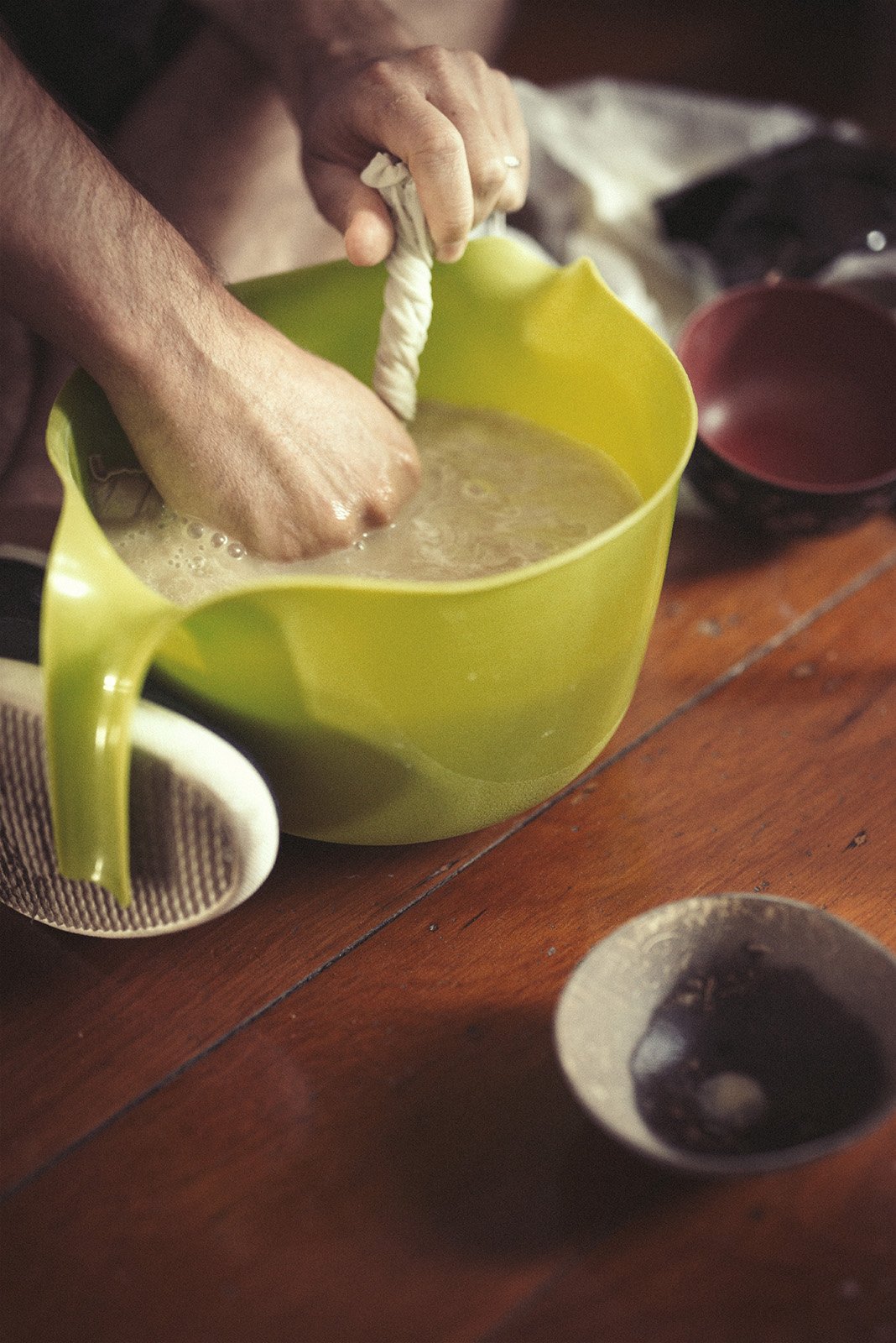
Fresh kava prepared traditionally using modern tools (cotton strainer bag and stainless steel bowl) in Vanuatu.
Making the most out of traditional kava preparation: guest post by Root & Pestle
Now, with that explanation out of the way, on to the topic of the day: the science behind traditional kava preparation, and more specifically what the science says about how to make the most of it. People often ask whether adding x, y, or z can help them extract more from their traditional grind powder, what water temperature works best, or whether they should do multiple washes (kneading the same powder again in fresh water) to get more bang for their buck. Our friends at Root & Pestle in Vanuatu have recently acquired some new equipment for their world-class lab and have started looking at these questions seriously. Today we share their study on multiple washes. There is a lot of inaccurate information about how effective traditional preparation is (some online sources claim only 10% of kavalactones get released), so this study addresses some of those claims head-on. Our short take: a small second wash combined with the first is reasonable if you want to stretch your kava or prepare it for a large group, but anything beyond that is overkill. Decide for yourself by reading their report below.
Multiple washes: new insights into the kava squeeze, by Root & Pestle R&D
There have been countless questions (and tips) about how to maximise the efficiency of an aqueous extraction of kava, or in other words, how to optimise the squeeze.
The compounds in kava powder are not fully transferred into the beverage during squeezing, but how do different variables affect strength and chemotype, and how much of the kavalactone content of traditional kava powder ends up in the prepared drink? Are some kavalactones extracted more easily than others? Do kavalactone ratios shift depending on technique, producing different subjective effects from the same powder?
Over the past few months we have invested a small fortune and untold hours running a wide range of experiments at our facility in Vanuatu. Our goal: separate myths from facts and provide empirical answers to kava squeeze questions that have, until now, been answered mostly anecdotally. Extensive data analysis is ongoing, and we will report findings as they become available, starting with this post.
Our investigations focus on quantitative analysis, with a few organoleptic observations along the way. The subjective experience is a significant part of kava: just because a method extracts more kavalactones does not mean you will prefer the resulting drink or the experience. Most agree that hotter temperatures negatively impact taste, and some drinkers do not want to spend ages preparing their kava. Preferences vary between tradition and technology.
This process has limitations. Although our lab is at the cutting edge in kava, we are fairly small in the grand scheme of scientific research. We did not probe deeply into bioavailability or other pharmacological attributes during this process. We simply prepared hundreds of beverages under different conditions and quantified their kavalactone concentrations. We have not submitted our results for peer review or publication in technical journals. We want to contribute directly to the knowledge base of kava drinkers.
Our specialised R&D team, with extensive technical and scientific backgrounds and substantial experience in kava, used advanced laboratory equipment and techniques to obtain these results. That said, nobody can tell you the best way to prepare your kava. We can only show how different methods affect kavalactone content and ratios. You will need to determine what works best for you through personal experimentation, as taste is subjective and so are the desired effects. We are here to share our findings, not dictate your preparation method. If you find our insights useful, great. If not, continue making kava the way you prefer. There is no single best method.
What we discovered about sequential squeezes
Compared to the total we were able to pull out of the kava powder using the gold standard for kavalactone extraction, a Thermo Scientific Dionex ASE 350 Accelerated Solvent Extractor running organic solvents at high temperatures and pressures with long hold times and large rinse volumes, here is how much of the combined six major kavalactones we extracted from the same kava powder on each normal squeeze in water:
- Squeeze #1: 51.16%
- Squeeze #2: 14.17%
- Squeeze #3: 6.25%
- Squeeze #4: 4.32%
- Squeeze #5: 3.12%
- Squeeze #6: 2.16%
- Squeeze #7: 1.68%
- Squeeze #8: 1.44%
Those eight successive squeezes of the same kava yielded a total kavalactone extraction efficiency of 84.31%.
We have seen extraction efficiencies reported as low as 15% of the available kavalactones elsewhere, and there are numerous factors that affect this beyond what we are exploring here. One extremely important but often overlooked example is not just how the kava is squeezed, but how it was processed before packaging. Factors such as the way kava is peeled, chopped, dried, and ground can influence how easy it is to pull kavalactones out of the powder, so two kava powders that test with similar kavalactone content may not extract the same way at home. That is something we have learned through years of experience.
The best portion of what is available is coming out in the first squeeze, but there can be value in further washes if you want to wring your kava out for everything it is worth.
It is also worth realising that the kava produced from our sequential washes was much more dilute than what came from a single squeeze. Even though we continued to extract kavalactones in subsequent washes, we ended up with much more liquid too. Kava from a single squeeze was more authentically similar to kava served in nakamals throughout Vanuatu, with its creamy and rich texture, but a second squeeze combined with the first produced a milder version that you may still find enjoyable. Beyond that, we found it too watered-down.
The extraction efficiency of each individual kavalactone was not identical under these conditions, but the chemotype of the prepared beverages closely reflected the chemotype of the powder, particularly in the first two squeeze cycles. Subsequent extractions saw the relative amounts of yangonin decrease while the relative amounts of desmethoxyyangonin, methysticin, and dihydromethysticin slightly increased. The relative amount of flavokavains decreased substantially across subsequent washes, and after five washes we could no longer quantify the very small amount of extracted flavokavains. The relative amounts of kavain and dihydrokavain, the two most abundant kavalactones in our powder, remained fairly consistent from wash to wash.

Root and Pestle's laboratory.
Methodology and instrumentation
For consistency in technique we used an automated system (essentially a glorified portable washing machine) to gently squeeze the kava in 28 degree Celsius (82.4 Fahrenheit) water for five minutes per squeeze cycle, followed by strong handwringing of the strainer bag between each successive squeeze.
We used 62.5 grams of kava in 1 L of water, collecting a sample and draining the liquid after each squeeze cycle, then cleaning the squeeze machine, returning the wrung-out strainer bag with the partially extracted kava powder still inside, and pouring in 1 L of fresh water for each subsequent squeeze. That came to a total of 8 L of prepared kava, which made for some seriously dilute drinks by the end.
The experiments were conducted using a traditional grind kava powder, derived from a blend of fresh green Vanuatu noble cultivars with a net chemotype of 423165 and containing 6.661% kavalactone content by weight (including the moisture content of the powder). We report our kavalactone concentrations based on the powder as packaged, rather than on dry weight. This is somewhat uncommon in the industry and results in reporting lower kavalactone levels, but it more accurately reflects the powder as used, and it makes it easier to understand what you are really working with.
Almost all water has impurities (or additives such as chlorine), and these can alter both the kavalactone content and the taste of the finished beverage. When we prepare kava for ourselves we usually use filtered rainwater, but we wanted to minimise variables in these tests, so the experiments were conducted using ultrapure water (measured at 18.2 megohms of resistance).
Samples were weighed to within 100 micrograms on analytical balances calibrated with certified class OIML E2 weights (uncertainty +/- 0.000016 g, NATA accredited for compliance with ISO/IEC 17025, laboratory No. 3279). All other instrumentation used was modern, fit for purpose, and well cared for, including our pipettes, which are serviced and calibrated by Eppendorf to ISO 8655-6:2022.
Samples from each squeeze were collected, lyophilised, then reconstituted in organic solvents matching the carrier for our analytical reference standards, filtered, and prepared for injection into our UHPLC system.
Kavalactone concentrations were analysed by qualified experts on our Thermo Scientific Vanquish Horizon Ultra-High-Performance Liquid Chromatography system, comprised of a VF-A10-A Split Sampler, VF-P10-A Binary Pump, VFD11-A Diode Array Detector, and VH-C10-A Column Compartment, fitted with a 200 x 2.1 mm Hypersil GOLD 1.9 micron particle size column, running the same instrument and processing methods (with Chromeleon 7.3.2 software) we use for reports destined for the FDA and other regulatory agencies.
UV detection was set at 362, 341, 246, and 218 nm, with peak identification assisted by elution time and spectrum matching, and relative quantification calculations were based on peak areas at 246 nm.
Correlation coefficients for all identified compounds were greater than 99.995% on a 20-point calibration curve derived by serial dilution of ampoules of Cerilliant certified analytical reference standards. Our lower and upper confidence probabilities were 99.5%.
Further reading from the Root & Pestle lab
- Optimal kava kneading and preparation time
- Best water temperature for making kava
- The blender method vs kneading: surprising findings
- Should you add fats to kava to get a stronger drink?
For a step-by-step guide to the squeeze, see how to prepare kava. Newcomers — our guide for new drinkers is the best place to start. It walks through forms, character types, and three first-time picks.






Leave a comment
This site is protected by hCaptcha and the hCaptcha Privacy Policy and Terms of Service apply.